Over the next decade, AI will become a normal everyday part of how small and medium UK businesses, particularly manufacturers plan work, run factories and compete, rather than a specialist add‑on reserved for large organisations. Those that treat AI as a practical tool for productivity, quality and resilience, rather than a science project or a rocket-scientist level pursuit will see higher margins, better delivery performance and stronger customer relationships.

The next 10 years in context
UK manufacturing productivity has lagged other major competitor countries for years, and policymakers now frame AI and automation as the main lever to close that gap with programmes like Made Smarter and regional grants specifically targeting SME adopters. Surveys show that while over half of manufacturers are experimenting with AI in some form, many smaller firms still sit in the “curious but cautious” camp due to cost, skills and uncertainty about where to start.
At the same time, broader AI trends in manufacturing point toward software‑defined, data‑driven factories where scheduling, maintenance and quality are driven increasingly by machine learning and agents working across hybrid cloud and edge systems. Over the next ten years, that shift will not eliminate people from the shop floor, but it will change many roles into controlling, supervising, troubleshooting and improving AI‑assisted systems rather than manually chasing every problem.
Practical use cases for SMEs
For most UK SME manufacturers, the earliest and highest‑return opportunities will be very specific applications rather than broad “AI transformation” initiatives in a big-bang way. Examples of these micro-wins might include demand forecasting to stabilise production, computer‑vision checks for critical dimensions, AI‑assisted scheduling to reduce changeovers, and predictive maintenance for a handful of bottleneck machines.
Language models and related tools already help with tasks such as generating work instructions, summarising/highlighting complex technical documents, translating technical papers for export customers and automating standard responses in customer service, all of which free up specialist staff for higher‑value work. Generative design and optimisation tools are starting to allow even smaller design and engineering teams to explore more lightweight or lower‑cost component geometries, which then flow directly into CAM and production planning.
How to get ready now
The most important preparation is not buying technology but building reliable data and clear problem statements, because nearly all high‑impact AI in manufacturing depends on good quality, structured data from apps and machines, quality records and business systems. The best way is to develop a staged approach that begins with connecting equipment, cleaning basic master data, and standardising processes, then layering in targeted AI pilots that are tightly scoped and measured.
People and culture matter as much as platforms: studies of successful adopters show that firms that invest in digital leadership training and preparedness workshopping, those that involve operators early and provide ongoing skills development see better ROI from AI and other Industry 4.0 investments than those that don’t. In the UK specifically, tapping into schemes like Made Smarter, regional catapults and university partnerships (like Knowledge Transfer) can reduce risk, provide impartial advice and part‑fund both experimentation and workforce upskilling.

Managing risk, governance and skills
As AI spreads through production and business processes, organisations will need to develop simple but explicit governance so that decisions about quality, safety and compliance remain clearly owned by humans even when algorithms provide recommendations. That includes basic model validation, clear escalation paths when AI outputs conflict with expert judgement and attention to data protection and IP, particularly when using cloud‑hosted tools and external LLM services.
Skills requirements will shift away from single-point specialisms toward hybrid profiles: technicians who understand both machines and data, engineers who can frame analytical questions, and leaders who can interpret AI‑driven scenarios without over‑trusting them. Given persistent skills shortages, SMEs that start now with modest internal capability building and partnerships, rather than outsourcing everything, will be better placed to absorb more advanced AI over the decade.
And looking forward, there are a range of technologies that will be fine-tuned and developed over the next 10 years.
Five booming technologies and what they mean
- Industrial AI and analytics platforms
These systems ingest data from machines, sensors and enterprise software to drive predictive maintenance, process optimisation and energy savings. For SMEs, they mean fewer unplanned stoppages on key assets, better OEE and the ability to run tighter inventories without losing service levels. - Generative AI and large language models
LLMs will mature from generic assistants into domain‑tuned “co‑pilots” for production engineering, quality, sales and administration. For manufacturers, they mean faster documentation, smarter quoting and design support, and easier knowledge capture from experienced staff before retirement. - Digital twins and simulation of factories
Digital twins link virtual models of machines, lines and even whole plants with real‑time data so that scenarios can be tested before changing the physical process. For SMEs, they offer a way to trial new product mixes, layouts or parameter settings virtually, reducing commissioning time, scrap and capital risk. - Collaborative robotics and physical AI
Falling prices and easier programming are bringing “cobots” and more autonomous robots within reach of smaller firms for tasks such as machine tending, assembly and intralogistics. In practice this means improved consistency, the ability to keep output up despite labour shortages and safer, less repetitive work for human operators. - Edge computing, 5G and industrial IoT
Connecting machines, tools and environmental sensors via industrial IoT, with local edge processing for latency‑sensitive applications, is becoming the backbone of smart factories. For SMEs, this means real‑time visibility of production, energy and quality, as well as the foundation to plug in new AI capabilities without re‑wiring the plant each time.
In real terms these technologies will often be consumed together, remixed, embedded in upgraded ERP and MES platforms, robotics cells, or OEM service contracts, rather than as stand‑alone tools that SMEs must integrate themselves. The strategic question for leaders however becomes which partners to choose, how to ensure data ownership and interoperability, and how to phase adoption so that benefits fund the next wave of investment.
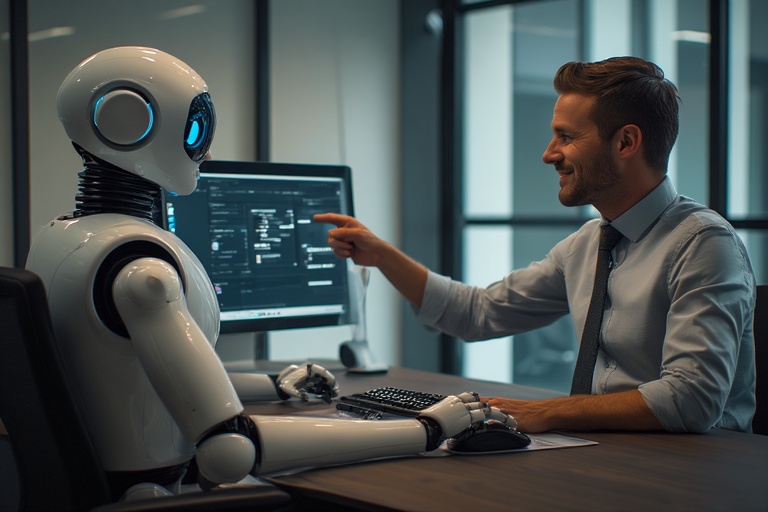
A concise way to think about the next ten years is that AI adoption will reward manufacturers who have clarity on where they create value, discipline in how they manage data and processes, and a learning culture that treats algorithms as collaborators rather than black boxes. Firms that postpone engagement risk finding themselves in a two‑tier economy where AI‑enabled competitors deliver more customised products, at lower cost and with shorter lead times, using similar labour and asset bases.
Over the coming decade, AI will not remove the need for experienced production leaders, engineers and operators for SMEs, but it will change how they work, the tools they use and the speed at which they can adapt. Those who start now with focused pilots, build skills systematically and choose technology partners carefully will be best placed to capture productivity gains, improve resilience and create more attractive workplaces for the next generation of manufacturing talent.
AI is moving very quickly from concept to practical, value‑adding capability in manufacturing, and small and medium businesses have a real opportunity to use it to compete on quality, responsiveness and innovation, not just on cost. For leadership teams that want to explore what this could look like in their own context, it is worth beginning with a structured conversation about strategy, data readiness and priority use cases, rather than a technology shopping list, and external partners can help facilitate that journey.
A professional, independent discussion about AI and automation can surface gaps and opportunities that are not always visible from inside the day‑to‑day pressures of running a factory, and can help shape a practical roadmap that fits budgets, skills and culture. Any organisation that is serious about embracing AI over the next decade and wants to translate these trends into a concrete plan for its own operations is encouraged to reach out for a detailed conversation about objectives, options and next steps.